MENU

Agencies across North America are modernizing their legacy paratransit systems, and measuring the impact through robust KPIs is essential when making such a significant investment. With ongoing budget and resource constraints, stakeholders and taxpayers need to know if they’re getting value for money with the procurement of new paratransit software. Further, agencies need to know if their specific requirements are being met by the new platform.
However, KPIs are only as good as the data that informs them. That’s why RideCo offers Data Insights, a comprehensive reporting suite that supports live service monitoring, standardized KPI reports, and raw transit data. It enables agencies to proactively monitor KPIs and make strategic, data-informed decisions that increase operational and cost efficiency, service quality, and system resilience. The following KPIs are just some of the metrics RideCo enables our agency partners to track, along with examples of how RideCo’s paratransit software can help keep these metrics favorable — all made possible by RideCo’s innovative, patented technology.
Passengers per vehicle hour (PVH) represents the average productivity of the agency’s fleet. It’s an indicator of efficient scheduling and routing, and higher PVH means reduced cost per ride. This is because efficient scheduling and routing results in less deadhead and increased vehicle utilization. With less overall revenue hours required, cost per ride is therefore reduced.
RideCo’s patented continuous optimization engine, Solver, enables agencies to achieve high vehicle utilization, while at the same time maintaining customer service levels through honoring the guaranteed arrives-before time provided to the passenger at the time of booking. Through Solver, RideCo’s Configuration Optimizer automates passenger assignment to specialized vehicles, ensuring all requested rides are serviced at the highest level of fleet productivity. All booked rides are optimized against every possible configuration, determining the best possible vehicle to accommodate each passenger’s mobility requirements while considering configuration priorities. Rides are continuously and dynamically re-optimized as new ones are booked.
Leveraging Solver and Configuration Optimizer, Kansas City Area Transportation Authority (KCATA) saw a 19% increase in PVH and a 16% decrease in cost per ride with their RideKC Freedom ADA-paratransit program. Regarding this improvement in vehicle productivity and cost efficiency, Tyler Means, Chief Mobility and Strategy Officer at KCATA, said:
We’re seeing consolidation, a higher level of efficiency and better use of shared rides, all thanks to the [RideCo] platform and its algorithm. … These efficiencies create a more convenient and reliable experience for [RideKC Freedom] riders while optimizing our resources.
Another important KPI agencies should proactively monitor is average trip negotiation, the process of adjusting the original requested pick-up time within an acceptable window that accommodates system efficiency and the rider's preferences, as well as program rules and ADA regulations. By tracking this metric over time, agencies can assess overall system capacity. Increases in average trip negotiation time can mean issues with service capability, while a significant decrease may represent an opportunity to support additional demand.
RideCo’s paratransit software automates the trip negotiation process in instances where the original requested time cannot be accommodated. It does so through global continuous optimization, finding the best fit available and proactively redistributing other trips as needed, all without intervention from reservationists. Configurable settings such as the trip negotiation window and direct and/or equivalent fixed-route trip duration are automatically applied to negotiated trips to maintain compliance with ADA regulations.
An example of this in practice is RideCo’s implementation with Southeastern Pennsylvania Transportation Authority (SEPTA). The agency has seen a 12.4-minute average trip negotiation time, 8.8% increase in average passengers per vehicle hour, and 8.9% increase in average passengers per weekday with its SEPTA Access program. The average trip negotiation time is a result of continuous optimization and higher vehicle productivity through Solver, which enables efficient use of available vehicle resources.
Average on-time performance leads directly to customer satisfaction, measuring whether or not the rider got to their destination when promised. This is particularly important for people who use paratransit services to get to work or attend appointments. Timely service matters.
Other technology vendors that provide paratransit software optimize either the pick-up or drop-off times and provide a floating estimated time of arrival. As demand increases, on-time performance can be jeopardized by the increase in trip requests. With floating pick-up and drop-off times, other vendors’ on-time performance is less standardized, and riders may miss connecting transit services, as well as work and appointment start times, by being even couple minutes late. In contrast, RideCo offers fixed, guaranteed arrives-before times to ensure riders can plan their trips, knowing they’ll arrive at their destinations on time.
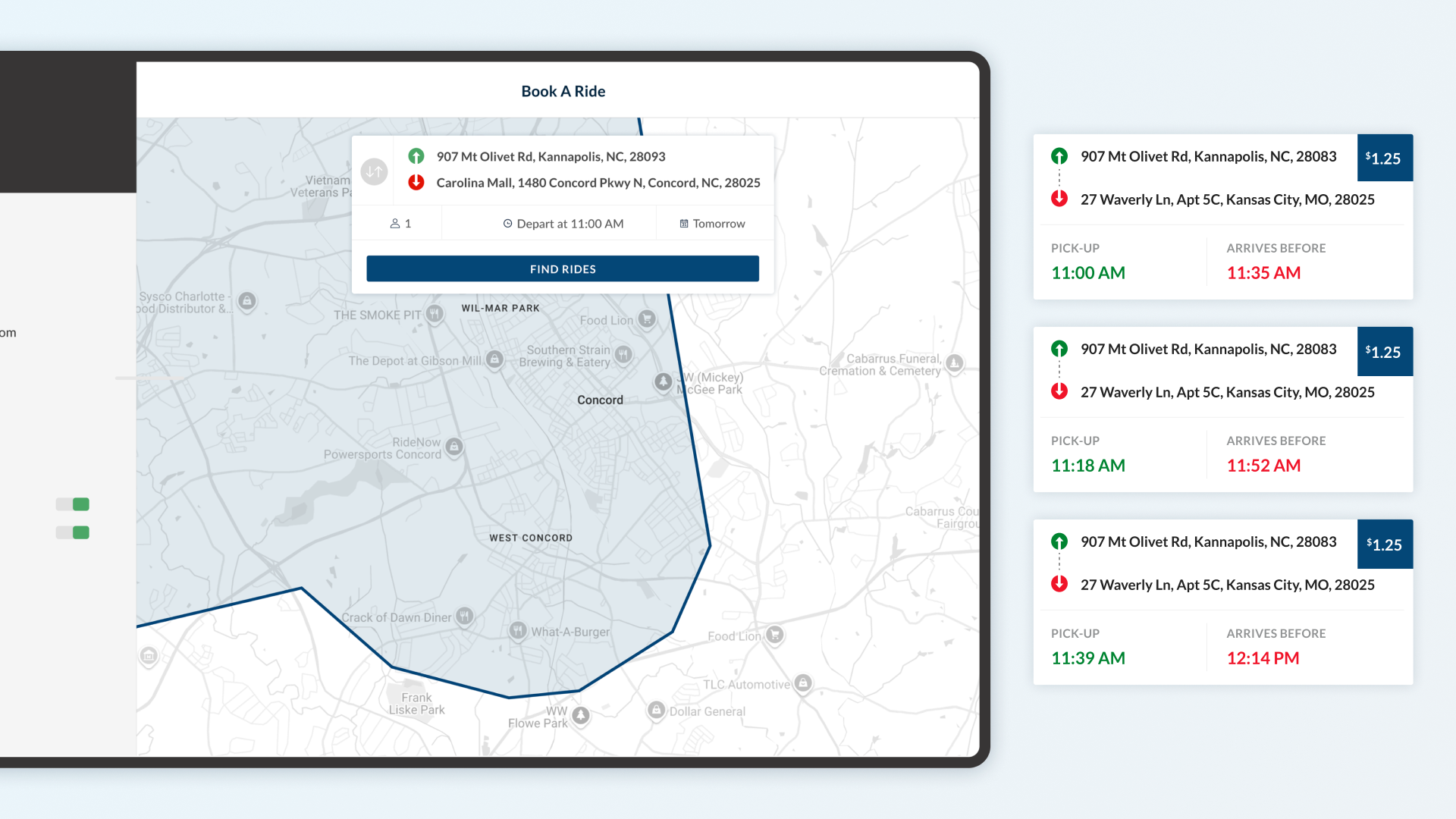
Concord Kannapolis Area Transit (Rider Transit)’s ADA-paratransit program boasts a 99% average on-time performance through RideCo’s paratransit software.
The most direct measure of customer satisfaction, however, comes from average ride rating. Overall service delivery and positive rider experiences lead to ridership retention and growth, strengthening the public’s trust in the system to meet the community’s transportation needs. RideCo is proud of the 4.8/5 average ride rating that is maintained across all RideCo-powered on-demand transit services, including the LinkAssist ADA-paratransit program with MetroLink Tulsa. Here, Scott Marr, CEO and General Manager, said:
Since implementing RideCo’s platform, we’ve seen noticeable improvements in both service reliability and customer experience. Our team has observed more efficient scheduling and stronger on-time performance, which has translated to a smoother experience for our riders. We’ve also received positive feedback from customers who appreciate the increased reliability and ease of booking rides. Riders have expressed greater satisfaction overall, especially with the ability to plan and manage trips more independently. It’s clear that modernizing our technology has had a real and positive impact.
Modernizing legacy paratransit systems is a long-term investment and KPIs help agencies define if and how the return on the investment materializes. If it does, those results can compound over time across both operational and cost efficiency, service quality, and system resilience. This speaks to the importance of implementing modernized paratransit software that not only allows for proactive monitoring of essential KPIs, but continuously optimizes the results that are being measured. Invaluable tools Data Insights enable agencies to make strategic, data-informed decisions, ensuring the outcomes are not one-off results, but that they continue to compound during ongoing budget and resource constraints, changing consumer expectations, and the ever-evolving technological landscape.