Product Features
Driver Alerts: Helping Paratransit Dispatchers Prevent Delays Before They Compound
BY
Zanir Jasani
|
4 min. read
On-time performance is one of the most important measures of a paratransit service. For riders who rely on paratransit to get to work, medical appointments, and connecting into other transit modes, a late trip is more than an inconvenience. As demand for paratransit grows and both fleet and staff resources remain limited, agencies need proactive dispatching teams that can protect on-time performance across the entire service, not just respond to individual late trips.
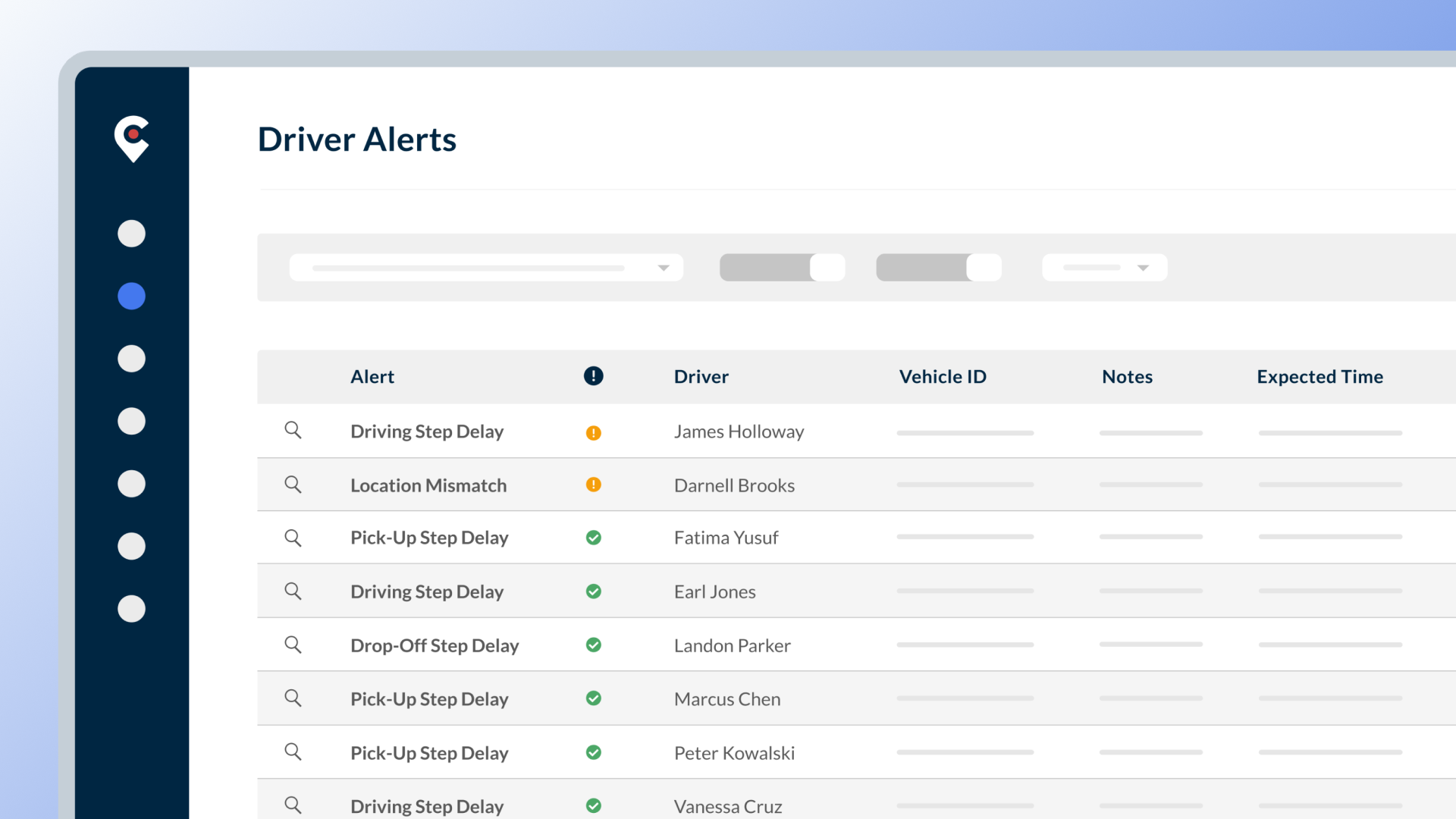
This Product Spotlight takes a close look at Driver Alerts, the real-time dispatching tool within RideCo’s Operations Center. The moment an unexpected incident begins to introduce lateness and delays, Driver Alerts tracks it, allowing dispatchers to act on it immediately and keep service running on time across the system.
Why Late Trips Are a Symptom, Not the Cause
Other technology vendors that provide paratransit software typically alert dispatchers once a trip is already running late. By that point, the window to prevent the delay has usually closed. The underlying cause, such as a trip that started late or a boarding that took longer than planned, occurred earlier in the schedule while the trip still appeared to be on time.
In paratransit, these delays rarely stay isolated. A few extra minutes at one pick-up location can push back every trip on a manifest, creating a compounding effect that impacts service quality well beyond a single trip. Preventing lateness requires knowing the moment there is a vulnerability, at every step of the service day.
Before the Trip Begins: Ensuring Service Starts on Time and in the Right Place
A reliable service day starts with drivers on the road and at the right locations. Driver Alerts notifies dispatchers if a shift has not begun by the expected time, putting the first trips of the day at risk. Dispatchers can then contact the driver immediately, while continuous dynamic optimization with Solver redistributes affected trips across the available fleet, before riders are impacted.
A location mismatch alert is logged the moment a vehicle arrives at a pick-up or drop-off location other than the one the passenger requested. Dispatchers can redirect the driver while the passenger is waiting at the correct location, reducing missed trips and no shows. When the same address triggers repeated mismatches, agencies can correct the location data, preventing the issue on future trips.
During the Trip: Identifying Delays at Every Step
Every paratransit trip is made up of distinct steps, each with an expected duration. Driver Alerts flags a driving step delay as soon as travel to a passenger’s origin or destination takes longer than anticipated: a pick-up step delay when boarding runs past the allotted time and a drop-off step delay when disembarking takes longer than planned.
Because each alert is logged the moment the delay occurs, dispatchers can see exactly where it begins rather than discovering it once the delay has compounded. A quick check in with the driver is often enough to resolve the issue, whether that means providing directions to the correct building entrance or arranging additional support at a pick up.
Across the Fleet: Maintaining Real-Time Visibility
Accurate, up-to-date information about every vehicle is essential for effective scheduling and reliable ETAs. A not polling alert notifies dispatchers as soon as a vehicle’s device stops sending GPS updates, so dispatchers can work with the driver to restore connectivity. An offline time alert indicates when a vehicle is unavailable to serve trips for any reason. While Solver automatically redistributes affected trips, dispatchers can follow up with the driver. Recurring alerts in a specific area can also help agencies identify coverage gaps.
From Real-Time Alerts to Better Service
Driver Alerts is designed to support drivers, not penalize them. Most delays are not intentional, rather reflecting the challenges of delivering paratransit service. When an alert appears, dispatchers can provide support immediately, communicating with the driver to help resolve issues then and there.
At MetroLink Tulsa, Driver Alerts is central to daily operations within the agency’s command center. Valerie Courchesne, Director of the Control Center at MetroLink Tulsa, said:
Driver Alerts—that’s the best thing I’ve ever seen. We have it on a big screen TV in our command center. If there’s a driver starting to fall behind, we can see exactly what’s going on. Is their schedule heavy and is there traffic in that area? We can stop the motion of that by putting [their trips] on an extra board and it’s a fast, easy move.
Beyond the Moment: Supporting Driver Training with Driver Scorecard
While Driver Alerts helps dispatchers and drivers in real time, RideCo’s Driver Scorecard is used to strengthen platform proficiency and effective utilization. Driver Scorecard provides a daily summary of on-the-road events that impacted service delivery, giving agencies and operators the insight needed to recognize patterns and provide driver re-training where it will have the greatest impact. Together, these two tools help agencies and operators support drivers both in the moment and over time.
Moving Forward
Every delayed paratransit trip has a starting point: a shift that began a few minutes behind, a boarding that ran long, or a vehicle the system could no longer see. Agencies that deliver reliable service and protect on-time performance are the ones whose dispatching teams can proactively identify these incidents and resolve them in real time. Driver Alerts gives dispatching teams this visibility, helping them build a rider-centric operation that extends from the command cente to every driver on the road.
To learn how Driver Alerts can support your dispatching team, book a demo with our team or contact us at letschat@rideco.com.